 Key Changer
- To transpose music, move every note by the same interval: pick the new key, write its key signature, then move each note the same number of lines and spaces.
- Re-work each accidental against the new key: moving from E♭ major down to D major, a B natural becomes A sharp. Flats do not always stay flats.
- For a B♭ clarinet or trumpet, write concert-pitch parts a whole step higher; for alto sax, a major sixth higher; for horn in F, a perfect fifth higher.
On this page
To transpose music, move every note up or down by the same interval. Wikipedia’s transposition article calls that interval “constant”: it is the same for every note in the piece. On paper, four steps do the job: choose the new key, write its key signature, move each note the same number of lines and spaces, then re-work each accidental against the new key. For a B♭, E♭ or F instrument, the instrument sets the interval. The last step is to check the result by ear.
Choose the new key and the interval
A transposition usually starts for one of three reasons: the music sits too high or low for a singer, the key is hard for the instrument, or the part belongs to a transposing instrument. Schmidt-Jones’s textbook names the first: moving the key into the singer’s range “will result in a much better performance”. A major key stays major, and a minor key stays minor: A minor up a minor third is C minor, not C major.
Name the move by letter names: D major up a whole step is E major; B minor down a major third is G minor. C to G is up a perfect fifth, or down a perfect fourth when a fifth lands the part too high.
If the job is only to shift a recording, skip the paper work: count the semitones between the two keys and move the audio by that number.
Write the new key signature first
Write the signature before moving a single note. The same textbook is blunt: “if you use the wrong key signature, the transposition will not work.”
The major scales chapter lists the sharps as F, C, G, D, A, E, B and the flats as B, E, A, D, G, C, F. In a sharp key the last sharp is a half step below the tonic; in a flat key, the second-to-last flat is the tonic. C to G gains one sharp, F♯, a half step below G.
A minor key borrows the signature of its relative major, whose tonic sits three half steps higher, the minor scales chapter says. G minor uses the two flats of B♭ major.
One signature covers every octave: “every B, E, and A in a composition with this key signature will be flat, regardless of octave”, the chapter notes. Two keys can sound the same: B major, five sharps, and C♭ major, seven flats. Write the easier one.
Move every note the same number of lines and spaces
Each note moves up or down the same number of lines and spaces as the key did. The textbook says: “Remember to count every line and every space, including the ones the notes start on and end on.” The signature then does the bookkeeping: “As long as your key signature is correct, you do not have to worry about whether an interval is major, minor, or perfect.”
Counting half steps instead is slower: the intervals chapter calls it “time consuming and often inaccurate”. An interval’s size is the number of lines and spaces between two notes.
Take a melody in D major: D–F♯–A–G–F♯–E–D, up a minor second. One letter up per note gives E♭–G–B♭–A♭–G–F–E♭, and each note sits in E♭ major, whose signature supplies the flats on E, A and B.
Raising each note a half step on its own letter gives D♯, F𝄪, A♯, G♯, E♯ (a double sharp on every F), and none of it fits the E♭ signature. If the move pushes the part too high, flip the interval: a perfect fifth up can become a perfect fourth down, the same letter an octave lower.
Re-work every accidental against the new key
An accidental is not carried over as a symbol; it is worked out again from the new key. The textbook’s rule: “Put the note on the line or space where it would fall if it were not an accidental, and then either lower or raise it from your new key signature.” Its example: a B♮ in E♭ major, moved down to D major, becomes A♯ — a half step above the key’s note in each: B♭ there, A here.
A C♮ in that key would move the same way: a half step below D major’s C♯ becomes a half step below E♭ major’s D — D♭. A flat has come from a natural, which is why the textbook warns: “Flats don’t necessarily transpose as flats, or sharps as sharps.”
Double sharps and double flats belong to the same pass: an accidental that raises a note the signature already makes sharp, or lowers an already-flat one, writes two of them on the new note.
Write a part for a B♭, E♭ or F instrument
A band part is rarely written at the pitch it sounds. Concert pitch, the pitch of a non-transposing instrument such as the piano, is the reference: Wikipedia’s transposing-instrument article explains that a B♭ clarinet sounds a concert B♭ on a written C, hence the name.
To write a concert-pitch part for the player, transpose in the opposite direction from the change in the part’s name: C part to B♭ part is up a whole step: the instrument sounds it a whole step lower. The textbook’s table:
| Instrument | Write the concert part |
|---|---|
| B♭ clarinet, B♭ trumpet, soprano sax | up a whole step |
| Tenor sax | up an octave plus a whole step |
| Alto sax | up a major sixth |
| Baritone sax | up an octave plus a major sixth |
| Horn in F | up a perfect fifth |
| Guitar, double bass | an octave above the sound |
The key signature moves the same way: concert E♭ major becomes F major for the clarinet, C major for the alto sax, B♭ major for the horn. A minor third down reaches the same letter as a major sixth up, an octave lower, so an alto part can be written two ways.
Transpose chord symbols on a lead sheet
A chord symbol is mostly note name. The chord symbols chapter splits one into root, quality, extensions and a bass note; only the root and the bass are note names.
So move the note names and leave the rest alone. G–Em–C–D7/F♯ up a whole step becomes A–F♯m–D–E7/G♯: the “7” stays, and the bass moves with the root. Spell the new roots for the new key: C–Am–F–G7 up a minor third is E♭–Cm–A♭–B♭7, not D♯ or G♯.
Guitarists can hand part of the job to a capo: a song in A♭, capo on the first fret, chords down one half step, and you “will be playing in G, a nice strong key for guitar, but sounding in A flat.”
Check the transposition by ear
The textbook ends where this guide ends: “Play the part you have transposed; your own ears will tell you where you have made mistakes.” Play the new line against the original.
If the music is already a score file, the MuseScore handbook’s Tools → Transpose does the whole move in one dialog; leave its “Transpose key signatures” box on so the signature moves too.
In the browser, Flat’s help page says its transposition tool, by interval, key or semitones, “is a premium feature, included with Flat Power”.
The check works only when the recording is in the key you wrote: play its first chord against the sheet; if they differ, count from the recording’s key.
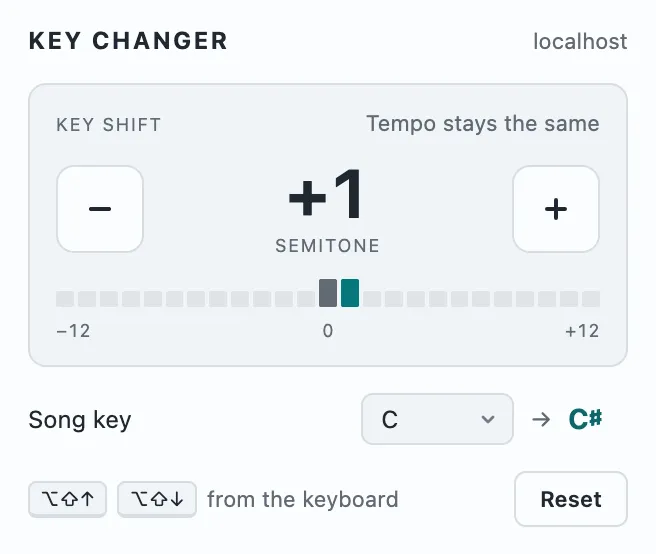
For hearing the recording in your chosen key, Key Changer, our Chrome extension, does the sound half of the job. Pick the song’s key in the Song key list; the popup shows the result: E♭ becomes C at −3, a minor key stays minor. Move the audio the same number of semitones the notes moved: a minor third is 3. Alt+Shift+Up and Alt+Shift+Down nudge the sound a semitone at a time, from −12 to +12, without the popup; the tempo stays the same. It processes the audio on the computer and uploads nothing; there is no account, and it needs Chrome 116 or later. Its limits: it changes sound only; no reading, rewriting or printing sheet music or chord charts, and no saved file. It does not find the song’s key, counts in semitones, not intervals, and names every key one fixed way (C♯, never D♭; G♯m, never A♭m), so the key signature spelling stays your call. Shifts of six semitones or more can sound less natural. It works on sound playing in a Chrome tab, Spotify web player included, which we checked by ear. Not on Chrome pages or the Chrome Web Store, not on protected (DRM) audio of some other paid streaming services, not when another sound extension holds the audio; embedded players: only YouTube and Vimeo, after Allow access. The shift resets on reload, another site and tab close.
Key Changer is an independent extension and is not affiliated with YouTube or Google.